Voice Care for Teachers and Professionals: Protecting Your Most Important Tool
Essential strategies for maintaining vocal health if you use your voice professionally, including prevention tips, warning signs, and when to seek help.
David Kim
Adult Speech Therapist

For teachers, salespeople, lawyers, clergy, fitness instructors, and many other professionals, your voice is your most important tool. You use it all day, every day, to inform, persuade, connect, and inspire. But unlike a laptop or phone, you can't simply replace your voice when it breaks down. And break down it can—research shows that an estimated 17.9 million American adults report voice problems, with professional voice users at significantly higher risk.
The good news is that most voice problems are preventable, and even when issues develop, early intervention leads to excellent outcomes. In this guide, we'll cover everything you need to know about protecting your voice, recognizing warning signs, and knowing when to seek professional help.
Understanding Your Voice
To protect your voice, it helps to understand how it works. Voice production happens when air from your lungs passes through your larynx (voice box), causing your vocal folds (commonly called vocal cords) to vibrate. These vibrations create sound waves that are then shaped by your throat, mouth, and nasal passages into speech.
Here's the key point: your vocal folds are small (about the size of your thumbnail) and delicate. During a typical day of speaking, they vibrate millions of times. Heavy voice use, like teaching a full day or giving multiple presentations, puts significant stress on this tissue—similar to how running puts stress on your knees and feet.
Your vocal folds vibrate approximately 100-200 times per second during normal speech. During a full teaching day, that adds up to millions of vibrations—which is why voice rest is so important.
Warning Signs of Voice Problems
Your voice often gives warning signs before a serious problem develops. Pay attention to these symptoms:
- Hoarseness or raspiness that lasts more than two weeks
- Voice fatigue—your voice feels tired or strained after speaking
- Reduced vocal range—difficulty hitting high or low notes you used to reach easily
- Frequent throat clearing or feeling of a lump in your throat
- Voice breaks or cuts out unexpectedly
- Pain or discomfort when speaking or swallowing
- Your voice sounds breathy, weak, or strained
- Need to strain or push to produce voice
- Voice is worse at the end of the day or week
If you experience any of these symptoms persistently, especially hoarseness lasting more than 2-3 weeks, consult a healthcare provider. While most voice problems are benign and treatable, persistent hoarseness can occasionally indicate serious conditions that need medical attention.
Voice Hygiene: Prevention Basics
'Voice hygiene' refers to habits and practices that protect your vocal health. Think of it like dental hygiene for your voice—daily habits that prevent problems before they start.
Stay Hydrated
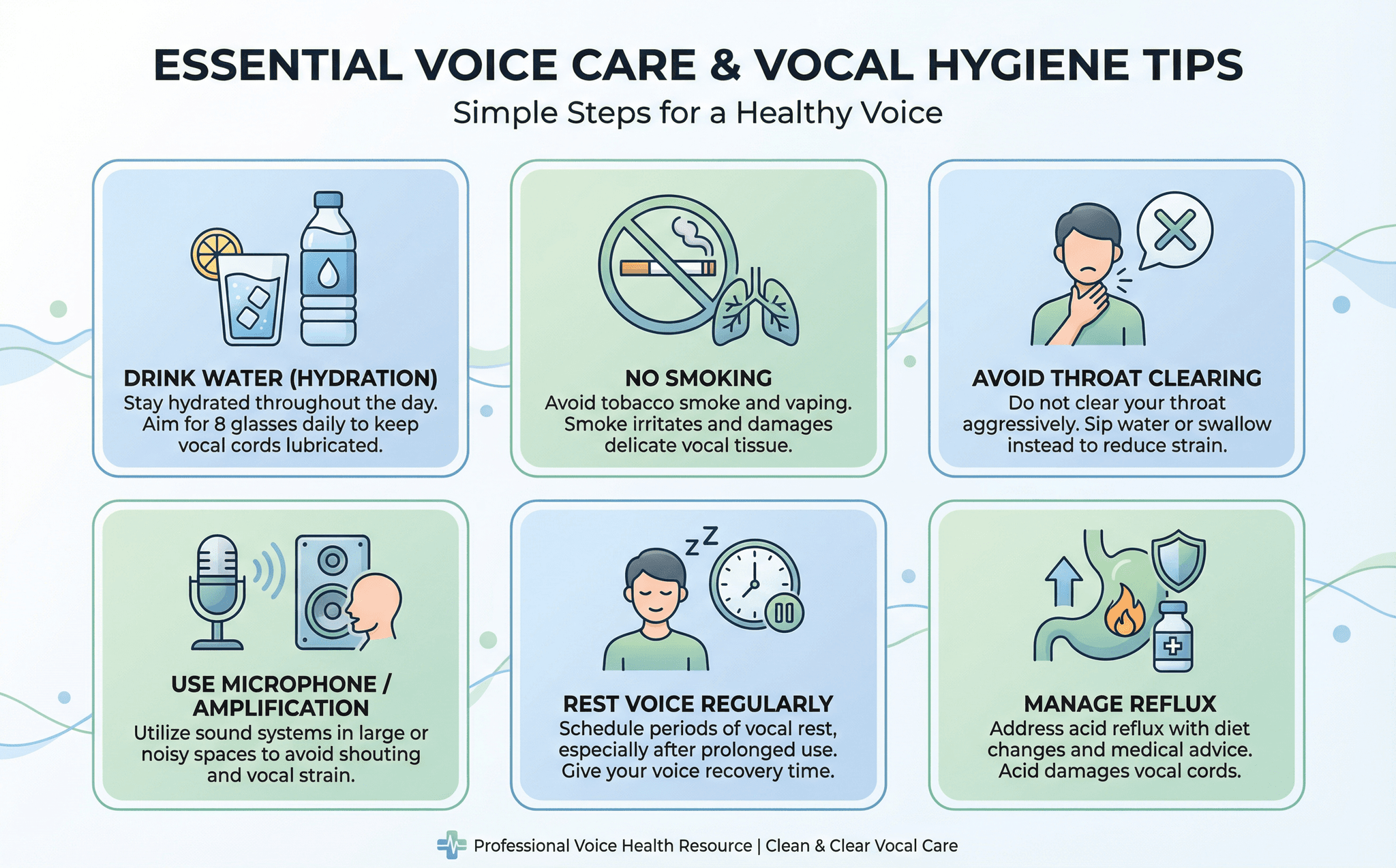
This is the most important voice care habit. Well-hydrated vocal folds vibrate more efficiently and are less prone to injury. Aim for 8-10 glasses of water daily, more if you're speaking extensively or in dry environments. Your urine should be pale yellow—darker urine suggests dehydration.
What counts as hydration? Water is best. Caffeine and alcohol have mild diuretic effects, so they don't count fully toward your fluid intake. Herbal tea (without caffeine) is a good option, especially warm liquids which can soothe the throat.
Avoid Throat Clearing
Chronic throat clearing is one of the most common causes of voice problems. When you clear your throat, your vocal folds slam together forcefully, causing irritation that makes you want to clear your throat again—a vicious cycle.
Instead, try these alternatives: swallow, take a sip of water, or do a silent 'yawn-sigh' (open your throat as if yawning and release air gently). If you frequently feel mucus in your throat, this may indicate allergies, reflux, or other conditions worth investigating.
Don't Whisper
Counterintuitively, whispering is harder on your voice than speaking normally. When you whisper, your vocal folds tense up in an unnatural position. If you need to rest your voice, silence is better than whispering.
Vocal Pacing: Your Voice Needs Rest
Just as runners pace themselves during a marathon, voice professionals need to pace their voice use throughout the day. This concept, called 'vocal pacing,' is essential for preventing voice problems.
Strategies for Vocal Pacing
- Schedule voice rest breaks throughout your day (5-15 minutes of complete silence)
- Use your lunch break for quiet time rather than socializing
- Delegate vocally demanding tasks when possible (have students read aloud, use volunteers)
- Plan your most vocally demanding activities for times when your voice is fresh
- Communicate non-verbally when appropriate (gestures, visual cues, written notes)
- Use technology to reduce voice demand (microphones, recordings, presentations)
For Teachers Specifically
Teaching is one of the highest-risk professions for voice problems. Teachers speak an average of 6-8 hours daily, often over background noise, in large spaces, and while managing student behavior. Here are teacher-specific strategies:
- Use a personal amplification system (voice amplifier) to reduce strain
- Establish non-verbal cues for classroom management
- Structure activities that give your voice a break (silent reading, partner work)
- Stay well-hydrated—keep water in your classroom
- Take complete voice rest during breaks and prep periods
- Avoid talking over student noise—wait for attention
Environmental Factors
Your environment significantly impacts your voice. Here's how to optimize it:
Humidity
Dry air dries out your vocal folds. Use a humidifier in your home and office, especially during winter when heating systems reduce humidity. Aim for 30-50% humidity. Steam inhalation (breathing over a bowl of hot water) can also help hydrate vocal folds directly.
Noise
Speaking over background noise (traffic, HVAC systems, student chatter) forces you to increase vocal effort. Whenever possible, reduce background noise or move to quieter spaces. When that's not possible, use amplification rather than raising your voice.
Air Quality
Smoke, dust, fumes, and air pollution irritate the vocal folds. Avoid smoking and secondhand smoke entirely. If you work in environments with air quality issues, consider wearing a mask or advocating for better ventilation.
Lifestyle Factors
Avoid Smoking and Excessive Alcohol
Smoking is the single worst thing you can do for your voice. It causes chronic irritation, increases cancer risk, and permanently damages vocal fold tissue. If you smoke, quitting is the best thing you can do for your vocal health. Excessive alcohol also irritates and dehydrates the vocal folds.
Manage Acid Reflux
Acid reflux, where stomach acid backs up into the throat, is a major cause of voice problems. 'Silent reflux' (laryngopharyngeal reflux or LPR) may not cause typical heartburn but can still damage your voice. Symptoms include chronic throat clearing, hoarseness worse in the morning, and feeling of a lump in the throat.
If you suspect reflux, dietary changes can help: avoid eating within 3 hours of bedtime, limit acidic, fatty, and spicy foods, reduce caffeine and alcohol, and consider elevating the head of your bed. If symptoms persist, consult your doctor.
Vocal Warm-Ups and Cool-Downs
Just as athletes warm up before exercise and cool down after, voice professionals benefit from vocal warm-ups and cool-downs.
Simple Warm-Up Routine (5 minutes)
- Gentle humming—start at a comfortable pitch and slide up and down
- Lip trills (making a 'motor boat' sound with your lips)
- Yawn-sighs—open your throat and release air on a descending sigh
- Gentle stretching of face, neck, and shoulder muscles
- Speaking a few sentences at increasing volume
Cool-Down After Heavy Voice Use
- Voice rest—complete silence for 15-30 minutes if possible
- Gentle humming at comfortable pitch
- Hydration—warm water or herbal tea
- Avoid talking on the phone or in noisy environments immediately after
When to Seek Professional Help
Don't wait until a serious problem develops. Seek professional evaluation if:
- Hoarseness lasts more than 2-3 weeks
- You experience pain when speaking or swallowing
- You have difficulty breathing
- You notice a lump or swelling in your neck
- Your voice problems are affecting your work or quality of life
- You've tried self-care measures without improvement
An ENT (otolaryngologist) can examine your vocal folds using a scope to diagnose any structural problems. A speech-language pathologist specializing in voice can provide therapy to improve vocal technique and rehabilitate vocal function.
Voice therapy is highly effective for most voice problems. Studies show that voice therapy alone resolves the majority of voice disorders without surgery, and it's essential for preventing problems from recurring.
Invest in Your Voice
Your voice is essential to your livelihood and identity. The strategies in this guide require some effort and habit change, but they're worth it. Taking care of your voice now prevents problems that could sideline you later and ensures you can continue doing the work you love for years to come.
If you're experiencing voice problems or want personalized guidance on protecting your voice, our voice specialists at Horizon Speech Therapy can help. We offer comprehensive voice evaluations, therapy, and coaching for professional voice users.
Need Help With Your Communication Goals?
Our team of experienced speech-language pathologists is here to help. Book a free consultation to discuss your needs.
Book Free ConsultationWritten by
David Kim
Adult Speech Therapist
David Kim is a licensed speech-language pathologist at Horizon Speech Therapy, passionate about helping clients achieve their communication goals.