Understanding Aphasia After Stroke: A Guide for Families
What is aphasia, how does it affect communication after stroke, and what can families do to support their loved one's recovery?
Dr. Sarah Chen
Lead Pediatric SLP

When someone you love has a stroke, the changes can be overwhelming. If the stroke affected the language areas of their brain, they may have developed aphasia—a condition that affects the ability to speak, understand speech, read, or write. Watching a parent, spouse, or friend struggle to communicate can be heartbreaking, especially when you don't know how to help.
This guide is for you—the family member, caregiver, or friend who wants to understand what aphasia is, what to expect during recovery, and how you can support your loved one. While aphasia is challenging, it's important to know that recovery is possible, and there's much you can do to help.
What Is Aphasia?
Aphasia is a language disorder that occurs when the language centers of the brain are damaged, most commonly by stroke. It affects approximately one-third of stroke survivors. Importantly, aphasia affects language, not intelligence—people with aphasia are still the same intelligent, capable individuals they were before. They know what they want to say; they just have difficulty getting the words out or understanding words coming in.
Aphasia can affect one or more aspects of language:
- Speaking: Finding words, forming sentences, speaking fluently
- Understanding: Comprehending spoken language, following conversations
- Reading: Understanding written words, sentences, and texts
- Writing: Spelling, forming sentences, expressing ideas in writing
Aphasia is NOT a mental illness, dementia, or sign of reduced intelligence. It's a language access problem, not a thinking problem. Think of it like trying to retrieve a file from a computer when the file names have been scrambled—the information is still there, but it's harder to access.
Types of Aphasia
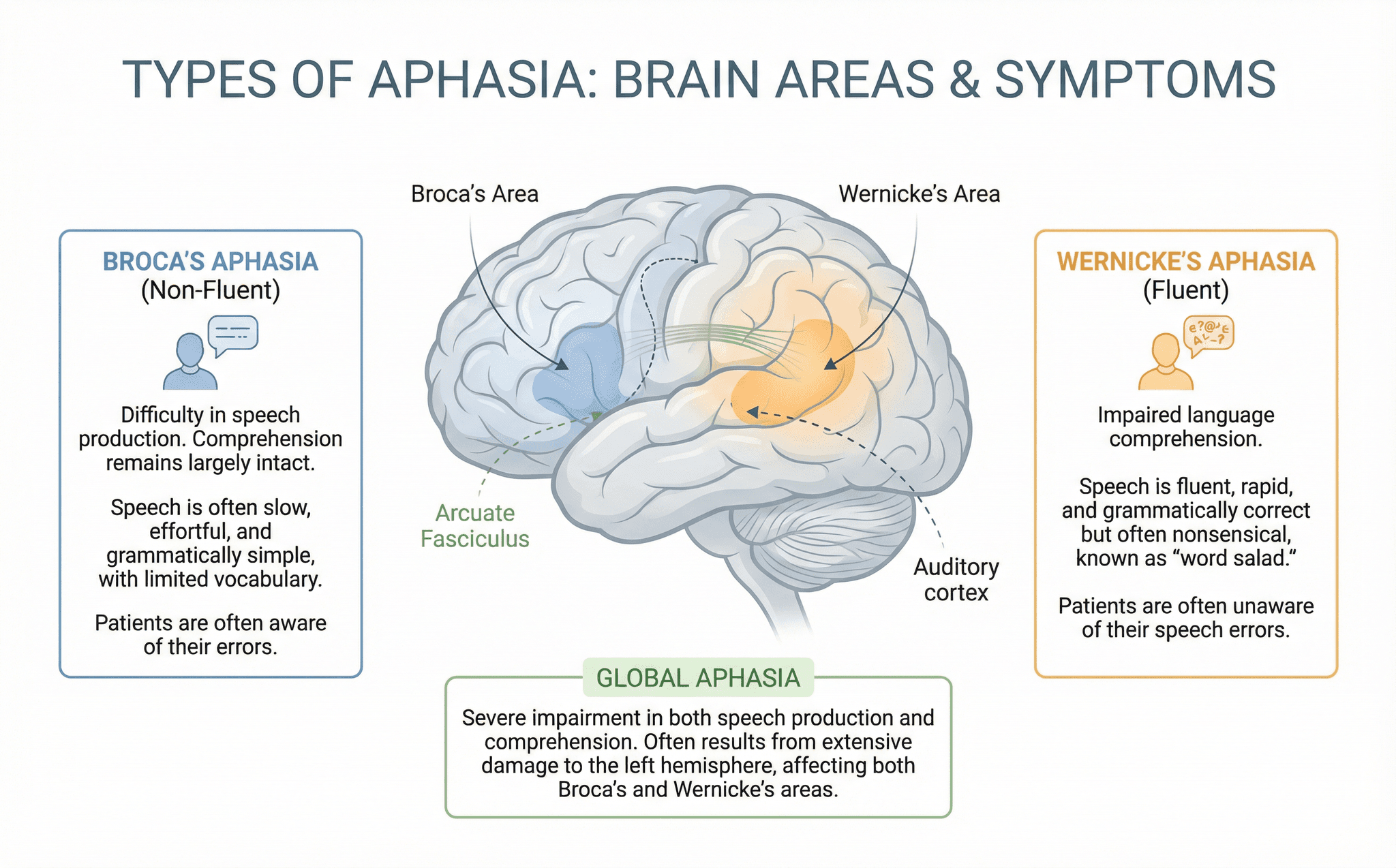
Aphasia varies widely from person to person, depending on which areas of the brain were affected. Here are the main types:
Broca's Aphasia (Non-fluent)
People with Broca's aphasia understand language relatively well but have difficulty speaking. Their speech is often halting, with short phrases and difficulty finding words. They typically know what they want to say but struggle to get it out. They often omit small words ('the,' 'is,' 'and') and may speak in telegram-style phrases ('Want... coffee').
Wernicke's Aphasia (Fluent)
People with Wernicke's aphasia speak in long, flowing sentences, but the content may not make sense. They may use incorrect words or made-up words without realizing it. Their understanding of language is significantly impaired, so they may not realize when others don't understand them.
Global Aphasia
The most severe form, global aphasia affects all aspects of language—speaking, understanding, reading, and writing. It typically results from extensive damage to language areas. While communication is very limited initially, improvement is still possible with intensive therapy.
Anomic Aphasia
The mildest form, anomic aphasia primarily affects word-finding. People understand language well and speak in fluent sentences, but frequently can't think of specific words—especially nouns and verbs. They might describe what they mean when they can't find the word ('you know, the thing you use to eat soup').
What Recovery Looks Like
Recovery from aphasia is possible, and most people show improvement. However, the recovery journey is different for everyone, and it's important to have realistic expectations while maintaining hope.
The First Few Months
The most rapid recovery typically occurs in the first 3-6 months after stroke, when the brain is healing and reorganizing. During this time, your loved one may make significant gains, sometimes week to week. This is a critical window for intensive speech therapy.
Long-Term Recovery
While the pace of recovery slows after the first several months, improvement can continue for years. Research shows that people with aphasia can continue making meaningful gains even decades after stroke, especially with ongoing therapy. The brain has remarkable plasticity—the ability to form new neural pathways.
Factors That Affect Recovery
- Size and location of the brain injury
- Overall health and age
- Motivation and emotional support
- Intensity and quality of therapy
- Practice outside of therapy sessions
- Communication opportunities in daily life
How Speech Therapy Helps
Speech-language pathologists (SLPs) are the professionals who diagnose and treat aphasia. Speech therapy for aphasia typically includes:
- Impairment-based therapy: Exercises to restore language functions (word retrieval, sentence formation, comprehension)
- Compensatory strategies: Alternative ways to communicate when words fail (gestures, writing, drawing, communication devices)
- Communication partner training: Teaching family members how to support communication
- Intensive practice: High-repetition exercises that promote brain reorganization
- Group therapy: Practice communicating in social situations with others who have aphasia
Research strongly supports intensive, long-term speech therapy for aphasia. Studies show that more therapy leads to better outcomes, and that therapy continues to help even years after stroke.
How You Can Help: Communication Strategies
As a family member or caregiver, you play a crucial role in your loved one's recovery. Here are evidence-based strategies for supporting communication:
Do's
- Speak naturally, using your normal tone and adult language
- Simplify, don't dumb down—use shorter sentences with key words
- Give them time to respond—resist the urge to finish their sentences
- Use multiple channels—supplement speech with gestures, pictures, or writing
- Confirm your understanding—'Are you saying you want coffee?'
- Include them in conversations, even if they can't fully participate
- Treat them with dignity and respect—they're still the person they always were
- Celebrate small successes and progress
Don'ts
- Don't talk about them as if they're not there
- Don't speak louder—they can hear you; it's language, not hearing, that's affected
- Don't use baby talk or oversimplified language
- Don't correct every error—focus on the message, not perfection
- Don't rush or finish their sentences unless they ask for help
- Don't pretend to understand if you don't—ask for clarification
- Don't exclude them from decisions about their own life
Supporting Emotional Wellbeing
Aphasia doesn't just affect communication—it impacts identity, relationships, independence, and emotional wellbeing. Depression and anxiety are common after stroke, and losing the ability to communicate makes these challenges even harder.
- Acknowledge their frustration—it's legitimate and understandable
- Maintain normal activities and routines as much as possible
- Help them stay connected with friends and family
- Look for support groups for people with aphasia and their families
- Watch for signs of depression (withdrawal, loss of interest, changes in sleep or appetite) and seek help if needed
- Take care of your own emotional health too—caregiver burnout is real
Aphasia support groups provide invaluable connection and understanding. Organizations like the Aphasia Institute and National Aphasia Association offer resources, groups, and programs for people with aphasia and their families.
Technology and Communication Aids
Technology can be a powerful tool for people with aphasia. Options include:
- Communication apps: Apps like Proloquo2Go, TouchChat, and Aphasia apps allow users to communicate using pictures, words, and text-to-speech
- Speech-generating devices: Dedicated communication devices for those with severe aphasia
- Therapy apps: Apps like Constant Therapy, Tactus Therapy, and Lingraphica provide practice exercises
- Video calling: Visual cues make communication easier than phone calls
- Text and email: Writing may be easier than speaking for some
The Road Ahead
Living with aphasia is a lifelong journey, not a destination. Some people recover nearly fully; others live with significant communication challenges long-term. Either way, life with aphasia can still be meaningful, connected, and fulfilling.
Your role as a family member or friend is invaluable. Your patience, support, and advocacy help your loved one maintain dignity, stay connected, and continue improving. It's not easy, but you don't have to do it alone.
At Horizon Speech Therapy, we specialize in helping people with aphasia and their families navigate this journey. From intensive therapy programs to communication partner training and support, we're here to help. Contact us for a consultation to discuss how we can support your family.
Need Help With Your Communication Goals?
Our team of experienced speech-language pathologists is here to help. Book a free consultation to discuss your needs.
Book Free ConsultationWritten by
Dr. Sarah Chen
Lead Pediatric SLP
Dr. Sarah Chen is a licensed speech-language pathologist at Horizon Speech Therapy, passionate about helping clients achieve their communication goals.