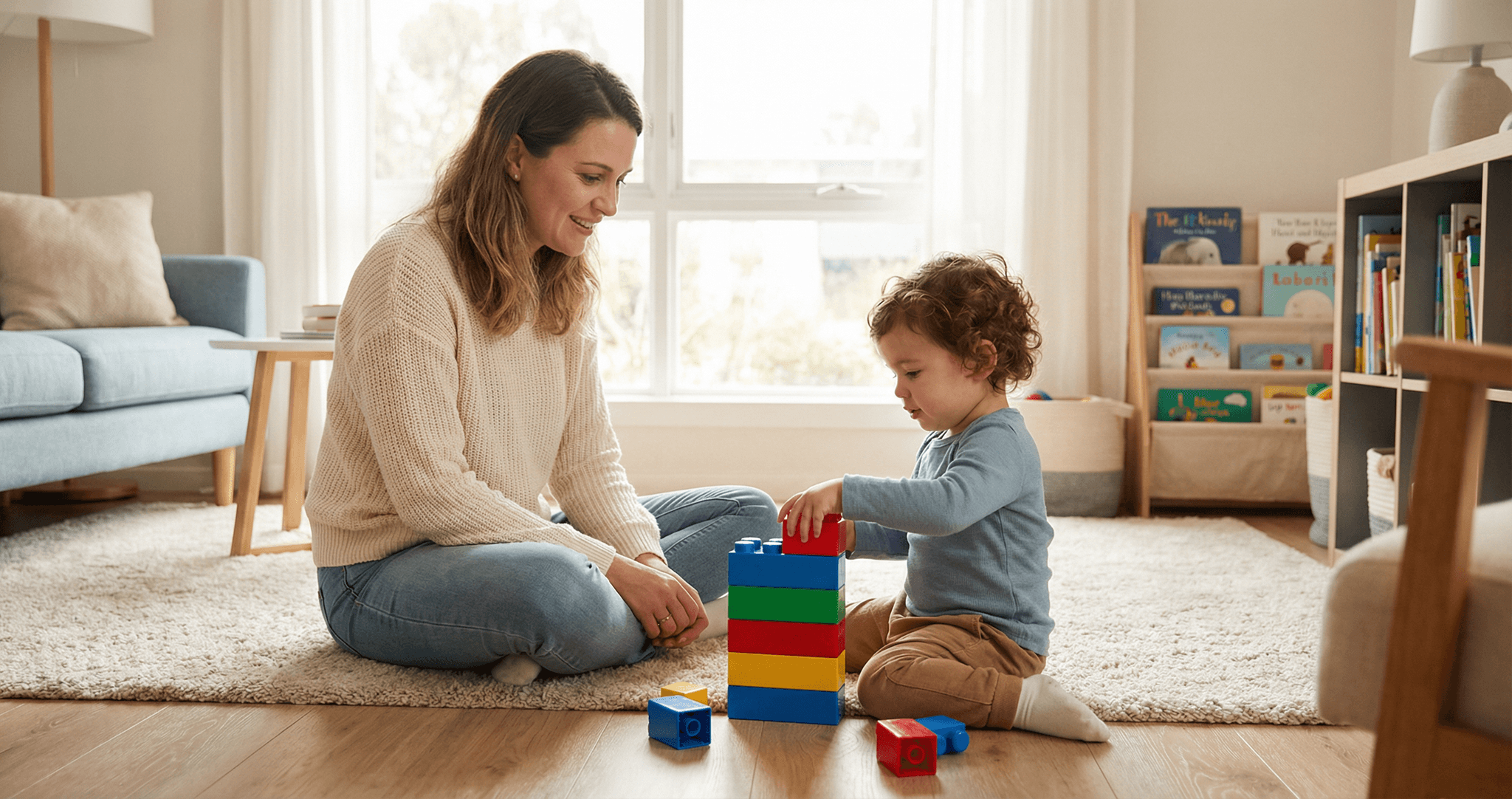
Your Child's Speech Milestones: A Complete Guide by Age
A comprehensive month-by-month guide to speech and language development from birth to age 5, including red flags and when to seek help.
Jennifer Park
Pediatric SLP

From a baby's first coo to a preschooler's endless questions, watching your child's language develop is one of the most rewarding aspects of parenting. But it can also be a source of worry—is my child talking enough? Are they on track? When should I be concerned?
As speech-language pathologists who work with children every day, we understand these concerns. In this comprehensive guide, we'll walk you through the typical speech and language milestones from birth through age 5, help you understand what's normal variation versus what might be a red flag, and give you practical tips for supporting your child's communication development at every stage.
Understanding the Difference: Speech vs. Language
Before we dive into milestones, it's important to understand that 'speech' and 'language' aren't the same thing, though we often use these terms interchangeably.
- Speech refers to the physical production of sounds—how clearly your child pronounces words and sounds
- Language includes understanding words and sentences (receptive language) and using words to communicate (expressive language)
- Communication also includes non-verbal elements like gestures, eye contact, and turn-taking
A child might have age-appropriate language skills but unclear speech, or clear speech but limited vocabulary. Both aspects are important for overall communication success.
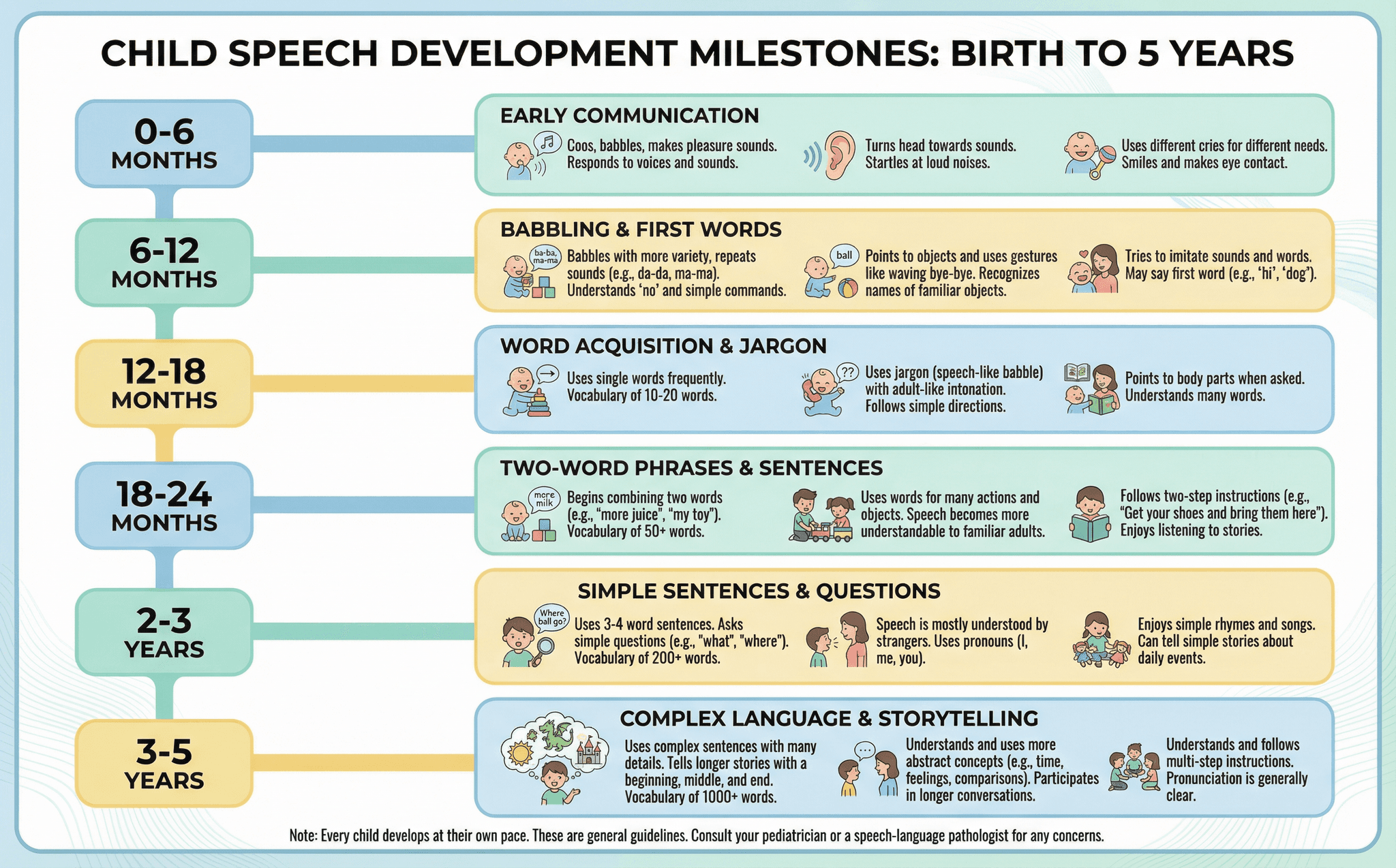
Birth to 6 Months: The Foundation
Long before your baby says their first word, they're building the foundation for communication. During these first months, babies are listening, observing, and beginning to experiment with sounds.
What to Expect
- Birth to 3 months: Startles at loud sounds, calms when spoken to, makes cooing sounds ('ooh,' 'aah'), cries differently for different needs
- 3 to 6 months: Turns toward sounds, watches your face when you talk, babbles with consonant sounds ('ba,' 'da'), laughs and squeals, begins to imitate sounds
Red Flags at This Stage
- Doesn't startle or respond to loud sounds
- Doesn't make any sounds by 4 months
- Doesn't turn toward voices or sounds by 6 months
- Doesn't smile or interact with caregivers
Support your baby's development by talking to them throughout the day, narrating your activities, and responding to their coos and babbles as if you're having a conversation.
6 to 12 Months: First Words Emerge
This is an exciting time! Your baby is beginning to understand that sounds have meaning and may produce their first words. Communication becomes increasingly intentional.
What to Expect
- 6 to 9 months: Babbles with more varied sounds ('bababa,' 'mamama'), responds to their name, understands 'no,' uses gestures like reaching and showing
- 9 to 12 months: Says first words ('mama,' 'dada,' 'bye-bye'), understands simple words and phrases, points to things they want, waves bye-bye, imitates sounds and gestures
By 12 months, most children have 1-3 words with meaning, though some perfectly typical children don't speak their first word until 14-15 months.
Red Flags at This Stage
- Doesn't babble with consonant sounds by 9 months
- Doesn't respond to their name
- Doesn't use any gestures (pointing, waving, showing) by 12 months
- Doesn't seem to understand any words
12 to 18 Months: Vocabulary Begins to Grow
During this period, your toddler's understanding of language explodes, even if they're not saying many words yet. They're absorbing everything and their receptive vocabulary far exceeds their expressive vocabulary.
What to Expect
- Uses 10-20 words by 18 months (these might not be perfectly clear)
- Follows simple one-step directions ('Give me the ball')
- Points to body parts when asked
- Points to pictures in books
- Uses gestures combined with sounds to communicate
- Understands many more words than they can say
Red Flags at This Stage
- No words by 16 months
- Doesn't point to show you things
- Doesn't follow simple directions
- Loss of words or skills they previously had
18 to 24 Months: The Language Explosion
Many children experience a 'vocabulary explosion' during this time, rapidly adding new words. They also begin combining words into simple phrases.
What to Expect
- Vocabulary of 50+ words by 24 months
- Begins combining two words ('more milk,' 'daddy go,' 'big dog')
- Follows two-step directions ('Get your shoes and bring them here')
- Points to pictures when you name them
- Speech is understood by familiar listeners about 50% of the time
At 24 months, the 'two-word' milestone is particularly important. Children should be regularly combining words, not just occasionally.
Red Flags at This Stage
- Fewer than 50 words by 24 months
- Not combining any words by 24 months
- Unclear speech that even parents can't understand most of the time
- Not interested in interacting with others
2 to 3 Years: Sentences and Conversations
Your child is now a little conversationalist! Sentences grow longer, questions emerge, and they can communicate their wants, needs, and ideas more clearly.
What to Expect
- Uses 200-1000+ words
- Speaks in 3-4 word sentences
- Asks simple questions ('What's that?' 'Where kitty go?')
- Uses plurals and past tense (though not always correctly)
- Strangers can understand about 75% of their speech
- Follows multi-step directions
- Engages in simple conversations
Common Speech Sound Errors
At this age, it's completely normal for children to have difficulty with certain sounds. Common substitutions include:
- 'W' for 'R' ('wabbit' for 'rabbit')
- 'D' for 'TH' ('dat' for 'that')
- 'T' for 'K' ('tat' for 'cat')
- Simplifying consonant clusters ('poon' for 'spoon')
3 to 4 Years: Expanding Communication
Language becomes more complex and sophisticated. Your child can tell stories, explain things, and engage in longer conversations.
What to Expect
- Uses 1000-2000 words
- Speaks in 4-5 word sentences
- Tells simple stories
- Asks many questions ('why,' 'how,' 'when')
- Speech is understood by strangers most of the time (75-90%)
- Uses correct grammar most of the time
- Can name colors, shapes, and letters
4 to 5 Years: School Readiness
As children approach kindergarten, their language skills should prepare them for academic learning and social interaction with peers.
What to Expect
- Speaks clearly enough to be understood by anyone
- Uses complete sentences with 5+ words
- Tells detailed stories with a beginning, middle, and end
- Follows classroom-style instructions
- Understands concepts like 'same/different,' 'first/last'
- Can rhyme and recognize beginning sounds in words
- Engages in complex pretend play with peers
When to Seek Help
Trust your instincts. As a parent, you know your child best. If something feels off, it's always worth getting a professional opinion. Here are some general guidelines for when to seek evaluation:
- If your child isn't meeting the milestones described above
- If your child loses skills they previously had
- If you consistently have trouble understanding your child
- If your child seems frustrated by their inability to communicate
- If teachers or caregivers express concerns
- If your child is significantly behind peers in communication
Early intervention makes a significant difference. If you have concerns, don't wait to see if your child 'grows out of it.' A speech-language evaluation can provide peace of mind or identify areas where support would be beneficial.
Supporting Your Child's Speech Development
Regardless of where your child is in their development, there are many things you can do at home to support their communication skills:
- Talk to your child throughout the day, narrating activities
- Read together daily—ask questions about the pictures and story
- Get on their level and make eye contact during conversations
- Give your child time to respond—don't rush to fill silences
- Expand on what they say (Child: 'Dog!' You: 'Yes, a big brown dog!')
- Avoid correcting errors directly; instead, model the correct form
- Limit screen time and prioritize face-to-face interaction
- Play together—play is how children learn language
Remember, every child develops at their own pace, and there's a wide range of 'normal.' The milestones in this guide are averages—some children reach them earlier, some later. What matters most is that your child is making progress and communicating in ways that work for them.
Need Help With Your Communication Goals?
Our team of experienced speech-language pathologists is here to help. Book a free consultation to discuss your needs.
Book Free ConsultationWritten by
Jennifer Park
Pediatric SLP
Jennifer Park is a licensed speech-language pathologist at Horizon Speech Therapy, passionate about helping clients achieve their communication goals.